| Supply Voltage and Current | 12 to 24V dc (10% max. ripple) @ 100 mA (exclusive of load)
|
| Range | 50 to 250 mm
|
| Ultrasonic Frequency | 400 kHz
|
| Supply Protection Circuitry | Protected against reverse polarity and transient voltages
|
| Output Configuration | Bipolar:One NPN (current sinking) and one PNP (current sourcing)
|
| Output Rating | 150 mA max. each output
OFF-state leakage current:less than 25 µA @ 24V dc
ON-State saturation voltage:less than 1.5V @ 10 mA; less than 2.0V @ 150 mA
|
| Output Protection Circuitry | Protected against continuous overload or short-circuit of outputs
|
| Output Response Time | 40 or 160 milliseconds selectable using switches
|
| Repeatability | ±0.2% of measured distance, specified using a 50 x 50 mm aluminum plate at 22° C under fixed sensing conditions.
|
| Temperature Stability | ±0.03% of the window limit positions per ° C from 0° to 50° C (±0.05% per ° C over remainder of operating temperature range)
|
| Sensing Window Width | 5 to 200 mm, when independent near and far limits are taught; 1, 2, 3 or 4 mm (switch selectable), when a sensing distance setpoint is taught
|
| Hysteresis | 0.5 mm
|
| Ultrasonic Beam Angle | ±3.5°
|
| Adjustments | The following may be selected by a 4-position DIP switch located on top of the sensor, beneath a transparent o-ring sealed acrylic cover:
Switch 1:output normally open (output is energized when target is within sensing window limits), or normally closed (output is energized when target is outside sensing window limits)
Switch 2 & 3:sensing window size (1, 2, 3 or 4 mm)
Switch 4:response speed selection (40 or 160 milliseconds)
|
| Indicators | 5-segment moving dot LED indicates the position of the target within the sensing window
3 LED indicators:Green, Yellow and Red
Green ON steady:power to controller is ON
Green flashing:output is overloaded
Yellow ON steady:outputs are conducting (yellow also indicates programming status during setup)
Red flashing:indicates relative signal strength of received echo
|
| Construction | Controller:Molded thermoplastic polyester housing, o-ring sealed transparent acrylic top cover, and stainless-steel hardware
Sensors:
M18C2.0:Stainless-steel M18 threaded barrel housing and jam nuts, polyetherimide front cover, ceramic transducer, polyurethane rear cover
S18C2.0:Thermoplastic polyester S18 threaded barrel housing and jam nuts, polyetherimide front cover, ceramic transducer, polyurethane rear cover
Q13C2.0:Molded 30% glass reinforced thermoplastic polyester housing, ceramic transducer, fully epoxy-encapsulated
|
| Environmental Rating | Controller:IEC IP67; NEMA 6P
Sensors:IEC IP65; NEMA 4
|
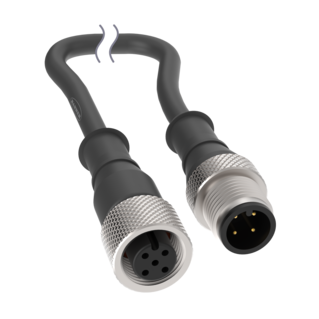
| Connections | Controller:5-conductor 2 m or 9 m shielded PVC-jacketed attached cable, or 5-pin Euro- or Mini-style quick-disconnect fitting. QD cables are ordered separately.
Sensors:2 m PVC-jacketed attached cable terminated with 4-pin Euro-style quick-disconnect fitting for connection to controller.
|
| Operating Conditions | Temperature:-25° to +70° C
Relative humidity:85% (non-condensing)
|
| Vibration and Mechanical Shock | All models meet Mil. Std. 202F requirements. Method 201A (Vibration: 10 to 60 Hz max. double amplitude 0.06”, maximum acceleration 10G). Method 213B conditions H&I (Shock: 75G with unit operating; 100G for non-operation). Also meets IEC 947-5-2 requirements: 30G, 11 milliseconds duration, half-sine wave.
|
| Application Notes | • The TEACH-mode function of the controller is used to set the sensing distance setpoint. The sensing window size is set using DIP switches #2 and #3. The sensing distance setpoint is centered within the sensing window. The size of the sensing window may be adjusted at any time, with or without power applied, and without re-teaching the sensing distance setpoint.
• The controller has non-volatile memory which remembers the last sensing distance setpoint setting if power is removed and later reapplied.
• The sensing distance setpoint may be programmed using the Remote TEACH input (see hookup diagrams).
• Acceptable target angle is within ±5° of normal for a smooth, flat target; target rotation does affect the apparent target location with respect to the sensor.
|