| Supply Voltage at the Device | 24V dc ±15% (SELV), ±10% max. ripple (The external voltage supply must be capable of buffering brief mains interruptions of 20 milliseconds, as specified in IEC/EN 60204-1). |
|---|---|
| Supply Current | Emitter:100 mA max. Receiver:275 mA max., exclusive of OSSD1 and OSSD2 loads (up to an additional 0.5 A each) |
| Resolution† and Operating Range (†No blanking enabled) | 14 mm resolution models:0.1 to 6 m 30 mm resolution models:0.1 to 18 m Range decreases with use of mirrors and/or lens shields: Lens shields:approximatel 10% of range per shield
Glass surface mirrors:approximately 8% less range per mirror
|
| Response Time | Dependent on number of sensing beams
10 beams:9 milliseconds 20 beams:11 milliseconds 30 beams:13 milliseconds 40 beams:15 milliseconds 50 beams:17 milliseconds 60 beams:19 milliseconds 70 beams:21 milliseconds 80 beams:23 milliseconds 90 beams:25 milliseconds 100 beams:27 milliseconds 110 beams:30 milliseconds 120 beams:32 milliseconds 140 beams:36 milliseconds 160 beams:40 milliseconds 180 beams:43 milliseconds 200 beams:48 milliseconds 220 beams:52 milliseconds 240 beams:56 milliseconds |
| CSSI Response Time (SLSC.. cascade models only) | Response time for a cascade receiver due to opening contacts at the cascade interface (CSSI) is 40 milliseconds max. (contacts must open for 60 milliseconds min.). |
| Remote Test Input (Optional - available only SLSE..-..Q5 emitters) | Test Mode is activated either by applying a low signal (less than 3V dc) to emitter TEST #1 terminal for a minimum of 50 milliseconds, or by opening a switch connected between TEST #1 and TEST #2 for a minimum of 50 milliseconds. Beam scanning stops to simulate a blocked condition. A high signal at TEST #1 deactivates Test Mode. (See p/n 112852 for more information.)
High signal:10 to 30V dc
Low signal:0 to 3V dc
Input current:35 mA inrush, 10 mA max.
|
| Wavelength of Emitter Elements | Infrared LEDs, 950 nm at peak emission |
| EDM Input | +24V dc signals from external device contacts can be monitored (one-channel, two-channel or no monitoring) using EDM1 and EDM2 terminals in the receiver. Monitored devices must respond within 200 milliseconds of an output change.
High signal:10 to 30V dc @ 30 mA typical
Low signal:0 to 3V dc
Dropout time:200 milliseconds max.
|
| Reset Input | The Reset input must be high for 0.25 to 2 seconds and then low to reset the receiver.
High signal:10 to 30V dc @ 30 mA typical
Low signal:0 to 3V dc
Closed switch time:0 .25 to 2 seconds
|
| Safety Outputs | Two redundant solid-state 24V dc, 0.5 A max. sourcing OSSD (Output Signal Switching Device) safety outputs. (Use optional interface modules for ac or larger dc loads.) Capable of the Banner “Safety Handshake”. ON-state voltage:greater than or equal to Vin-1.5V dc
OFF-state voltage:1.2V dc max. (0-1.2V dc)
Max. load capacitance:1.0 µF
Max. load inductance:10 H
Leakage current:0.50 mA max.
Cable resistance:10 ohms max.
OSSD test pulse width:100 to 300 microseconds
OSSD test pulse period:5 to 27 milliseconds (varies with number of beams)
Switching current:0-0.5 A
|
| Controls and Adjustments | Emitter: Scan Code selection:2-position switch (code 1 or 2). Factory default position is code 1.
Receiver:Scan Code selection:2-position switch (code 1 or 2). Factory default position is code 1.
Trip/Latch Output selection:Redundant switches. Factory default position is T (Trip)
EDM/MPCE Monitor selection:2-position switch selects between 1- or 2-channel monitoring. Factory default position is 2.
Reduced Resolution (2-beam Floating Blanking):Redundant switches to enable. Factory default is OFF.
|
| Short Circuit Protection | All inputs and outputs are protected from short circuits to +24V dc or dc common |
| Electrical Safety Class (IEC 61140: 1997) | III |
| Safety Rating | Type 4 per IEC 61496-1, -2; Category 4 per ISO 13849-1 (EN 954-1) |
| Ambient Light Immunity | Greater than 10,000 lux @ 5° angle of incidence |
| Effective Aperture Angle (EAA) | Meets Type 4 requirements per IEC 61496-2, ±2.5° @ 3 m |
| Enclosure | Material:Extruded aluminum housing with yellow polyester powder finish standard and well-sealed, rugged die-cast zinc end caps, acrylic lens cover, copolyester access cover. End caps on silver models are also nickel-plated. ESD-safe models have static-dissipative acrylic lens cover. |
| Environmental Rating | IEC IP65 |
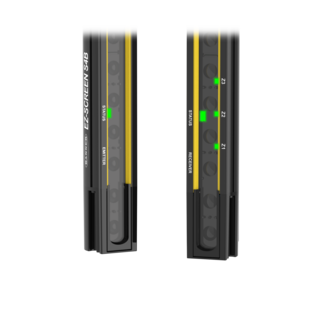
| Status Indicators | Emitter: One bicolor (Red/Green) status indicator:indicates operating mode, lockout or power OFF condition
7-segment Diagnostic indicator:indicates proper operation, scan code or error code
Receiver:Yellow Reset indicator:indicates whether system is ready for operation or requires a reset
Bicolor (Red/Green) Status indicator:indicates general system and output status
Bicolor (Red/Green) Zone Status indicators:indicates condition (clear or blocked beam) of a defined group of beams
7-segment Diagnostic indicator:indicates proper operation, scan code or error code, total number of blocked beams
|
| Mounting Hardware | Emitter and receiver each are supplied with a pair of swivel end-mounting brackets. Models longer than 900 mm also include a swivel center-mount bracket. Mounting brackets are 8-gauge cold-rolled steel, black zinc finish. |
| Shock and Vibration | EZ-SCREEN components have passed vibration and shock tests according to IEC 61496-1. This includes vibration (10 cycles) of 10-55 Hz at 0.35 mm single amplitude (0.70 mm peak-to-peak) and shock of 10 g for 16 milliseconds (6,000 cycles). |
| Operating Conditions | Temperature:0° to +55° C Relative humidity:95% (non-condensing) |
Industry solutions, application tips, new products, quick video tutorials, trends.
Subscribe Now »Is your line competitive? Innovative, high-quality solutions for every phase of production. Enjoy increased accuracy, greater productivity, cost savings.
Learn more »Banner has more than 2,000 distributors worldwide - ready to help you.