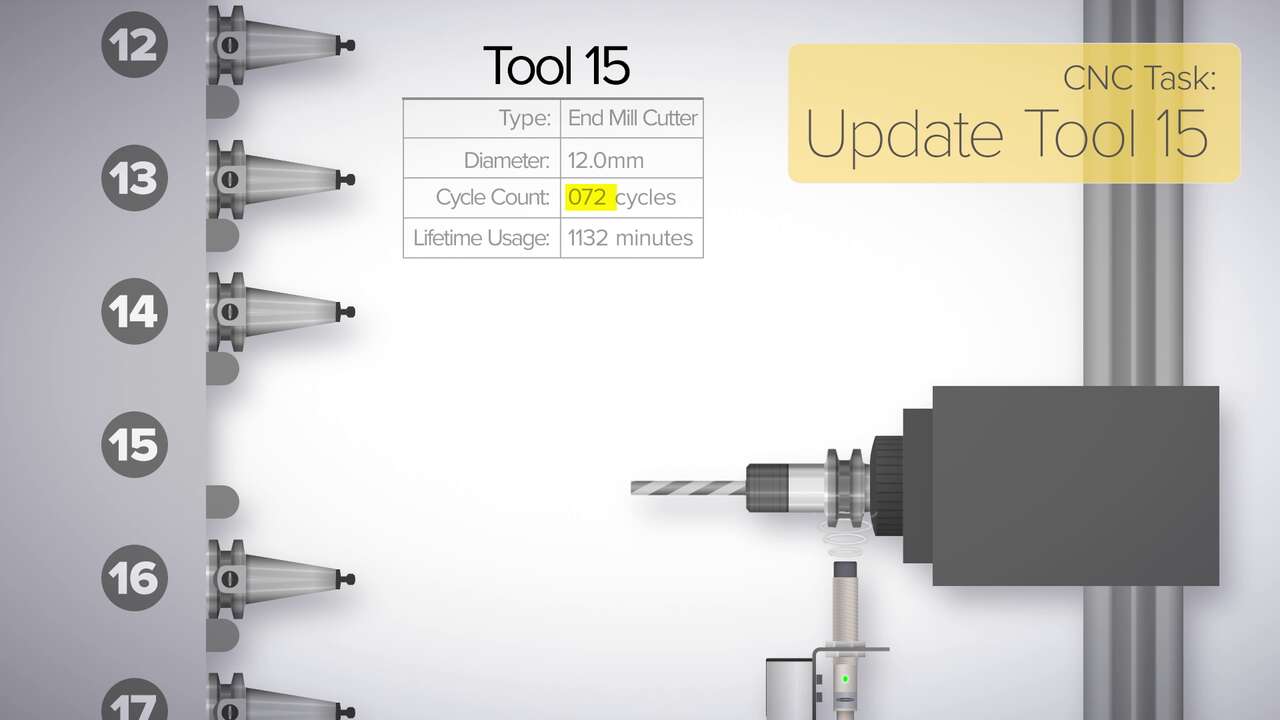


IO-Link RFID Tag Readers
Watch this video for a demonstration on how to run the IO-Link RFID tag readers; as well as how to read the tag information and unique identifier, and how to write information.


Rugged IP67-rated construction, available in compact cylindrical and rectangular form factors, stands up to the demands of a wide range of industrial environments. From shipping and production areas to washdown and outdoor operations, HF RFID Read/Write Heads make it easy to build identification and data capture into every step, improving efficiency and reducing waste.
Whether building up a new inventory with our HF RFID tags or using existing inventory, HF RFID Read/Write Heads work with any standard HF RFID tags, ensuring compatibility across mixed tag inventories and applications. Our selection of tags includes models that can be embedded in metal surfaces, mounted on metal surfaces, or mounted on non-metal surfaces.
HF RFID Read/Write Heads are available with IO-Link or Modbus communication, enabling identification and tracking data to flow directly into PLCs, HMIs, SCADA systems, or cloud platforms where it can be compiled, visualized, and acted on in real time.
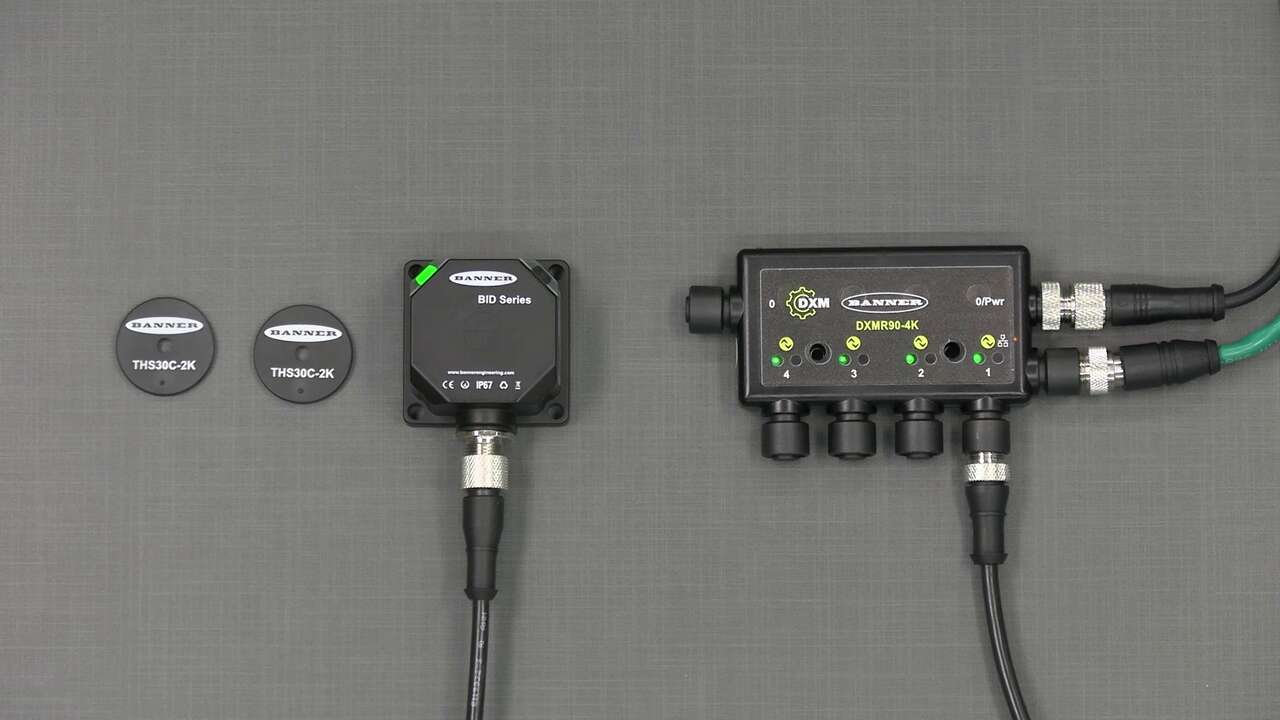
Watch this video for a demonstration on how to run the IO-Link RFID tag readers; as well as how to read the tag information and unique identifier, and how to write information.
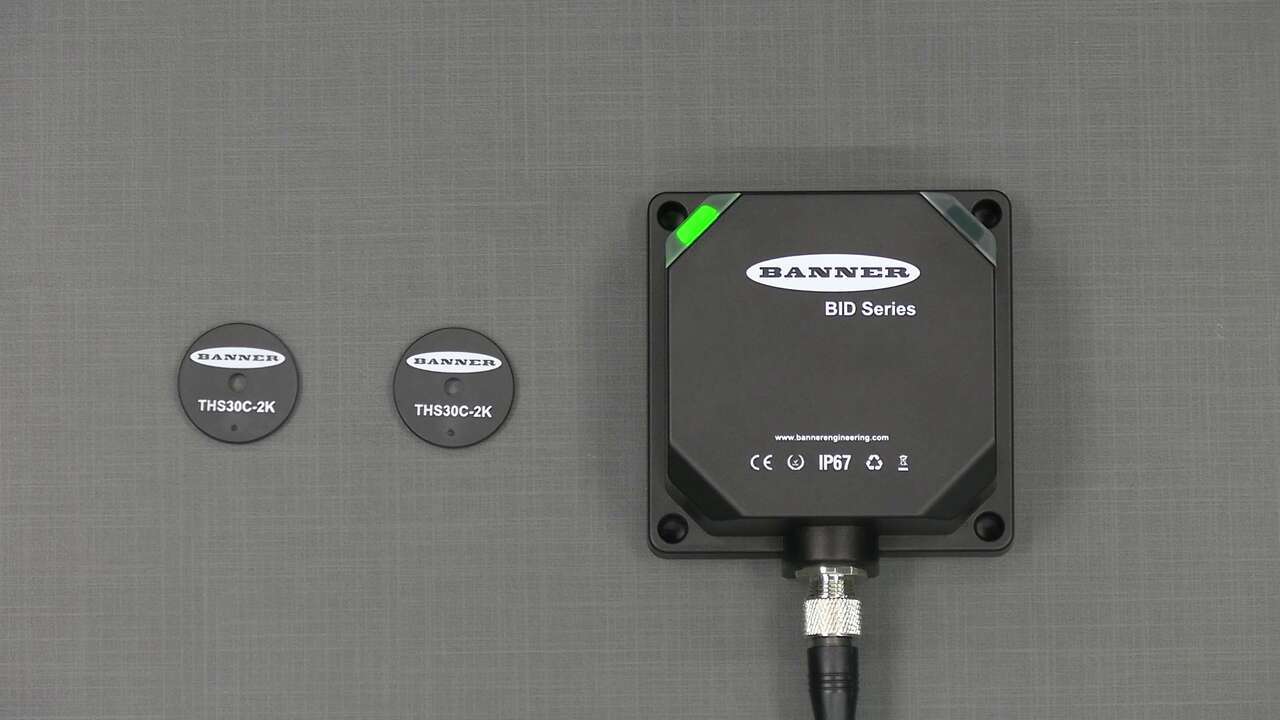
Watch this video for a demonstration on how to set up the Modbus RFID tag readers, read and write tags, and read the unique tag identifiers.
Yes! All Banner HF tags work with any Banner HF reader.
Yes! Any tag that follows the ISO 15693 High Frequency RFID protocol will work.
Tags are available with 112 bytes or 2,000 bytes (2K) of user memory in multiple shapes, including metal-mount versions like THQ40CM, THQ66CM, and THB14M5C.
Yes. Tags are rated for 100,000 write cycles.
Range depends on the reader model, tag type, and environment. Typical maximums (non-metal):
For best performance, the tag should be located parallel and as close to the reader as possible. The reader can still detect angled tags, but signal strength will be reduced.
Orientation, tag motion, mounting on metal, and distance all affect range. For moving tags, stay within ~85% of the maximum range and avoid being closer than 30% of that distance. Always test before final installation.
Yes. Use metal-mount tag models when needed. For readers mounted on metal, insert a ≥20 mm non-metal spacer between the reader and surface, or allow about 100 mm clearance if embedding.
The tag will resist paint buildup to a point, but performance depends on paint type, tag model, and distance. We recommend testing your setup to ensure performance remains acceptable.
Mount multiple readers ~2.5 m apart in metal frameworks and keep tags outside the minimum tag-to-tag distance to prevent interference.
Yes. Use Command 17 (read) or Command 18 (write), specify the start address and length, then trigger New Job.
RSSI (Received Signal Strength Indicator) shows how strong the tag’s signal is. The highest value for Banner readers is 3.
5-pin A-code M12 connection:
Yes! The best option is to use an R70 serial data radio, then connect another R70 to a DXMR90-X1E gateway, which can pass data to nearly any industrial system via Ethernet.
Device ID 2, 19200 baud, N-8-1 (no parity). ID range is 1–247, and baud can be set from 9600–115200.
5-pin A-code M12 connection:
Read registers 32782–32785 as a single command. If no tag is present, the reader returns code “04.”
Access registers 0–32767 (read/write in groups of four).
RSSI represents the tag’s signal strength. The scale runs from 0 to 3, with 3 being the strongest.
We recommend the DXMR90-X1E Industrial Gateway/Controller. It supports hundreds of Modbus devices, including RFID read/write heads, and provides seamless communication to EtherNet/IP®, PROFINET®, Modbus TCP, and MQTT networks.
No. They are not certified for IS/ATEX/IECEx use. Only deploy in non-hazardous environments unless the system provides approved protection.
No. Standard M12 cables work for both Modbus and IO-Link readers. Popular options include:
Our application engineers are here to help with expert guidance and support. Send us your inquiry, and we’ll get back to you as soon as possible. We’re here to make sure you get the answers you need.