Improving Efficiency in Material Delivery to Injection Molding Equipment
Sussex IM designs and produces many different injection molding components for companies across the manufacturing spectrum, including consumer products, industrial goods, agriscience, medical and pharmaceutical, and components for residential homes and appliances. Operating more than 60 injection molding machines that range from 25 to 725 tons, Sussex IM thrives on continuous improvement and innovation to satisfy customer needs.Sussex IM identified this material delivery process as an area that needed attention as this critical system had reached the end of its life. There were few replacement options, and those that were available were very costly and had not changed much over the past 25 years. Any solution would also have to integrate with the existing monitoring platform. Additionally, because the equipment was spread out on multiple levels across the facility, hard-wiring everything back to a central location was not feasible.
Challenge:
Modernizing Material Delivery Process
A critical process in injection molding is the delivery of raw plastic pellets to the dryers, then to the hoppers located near the injection molding equipment. An automated process sent material to the hoppers, but because there was no way to prioritize which machines received materials, hopper refills were inconsistent. There was also no real-time visibility into the temperature of each dryer, which had a closed loop controller to manage the temperature but could not communicate this value anywhere but on the local controller display. Though the controller offered a serial interface to access data, it was not yet connected.
Sussex IM identified this material delivery process as an area that needed attention as this critical system had reached the end of its life. There were few replacement options, and those that were available were very costly and had not changed much over the past 25 years. Any solution would also have to integrate with the existing monitoring platform. Additionally, because the equipment was spread out on multiple levels across the facility, hard-wiring everything back to a central location was not feasible.
Solution:
Installing New System Using Banner’s Snap Signal
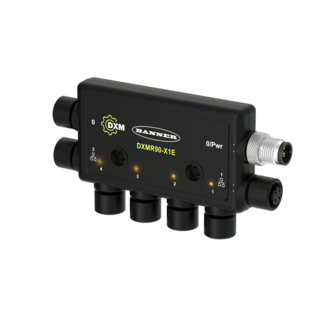
Easily installed on existing equipment and integrated into their control system, a Snap Signal system provided Sussex IM both the monitoring and control they desired. A hybrid wired/wireless architecture was chosen, with an R70SR Serial Data Radio installed on the main control panel and on each dryer and hopper. A DXMR90-X1 Industrial Controller at the main control panel served as the gateway for monitoring the entire system and sending that data to Sussex IM’s existing monitoring system.
Each dryer employing a wireless connection was equipped with two S15C-B22-MQ converters to drive two pneumatic valves, one for purge and one for sending material to the hoppers. Another S15C was added to monitor a proximity switch that indicated when the dryer required refilling. The temperature controller’s onboard serial interface integrated seamlessly into the system.
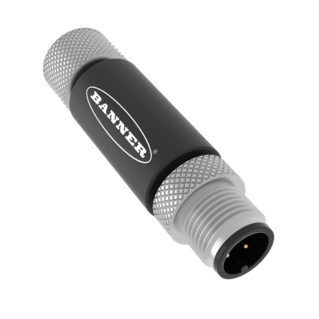
On the hoppers, an S15C converter read the status of a proximity switch that indicated the hopper received the material sent from the dryer and that it was full. Another S15C converter was added to control the hopper’s fill valve. Banner cordsets and splitters connected S15Cs on both the dryers and hoppers to R70SR Serial Data Radios, which sent data back to the main panel. Instead of S15C converters, the parts of the system that are wired used R95C Series 8-Port Hubs to directly change the I/O signals to Modbus®.
Conclusion
Following the installation, Sussex IM saw an immediate 22 percent decrease in technician bells in the area, and eliminated the costliest issue of overheating material. Using Modbus and wireless radios not only allowed removal of 20,000 feet of copper wire running through building, but also eliminated hundreds of hard-to-service junction points throughout the ceiling.
Benefits
Snap Signal Provides Greater Visibility Into Equipment Health
The new monitoring capabilities provided by Banner’s Snap Signal family gave Sussex IM greater insights into both the health of their equipment and the flow of raw materials to their dryers and hoppers. Added visibility of hopper fill status increased material delivery efficiency, enabling filling when necessary as well as priority-based fill scheduling. Real-time dryer temperatures could now be monitored remotely from the main dashboard, reducing the amount of time required by manual checks and allowing faster reactions to problems that arise. Increased feedback alongside custom programming allowed a more comprehensive system that is easier to use, with handlers better understanding the system and becoming more involved in the operation. It also dramatically lowered costly material errors such as over- and underfilled hoppers and line clogging.
Eliminating Compatibilty Issues Allows Easy Component Integration
Snap Signal’s flexibility allowed Sussex IM to easily integrate parts such as proximity switches and pneumatic valves without compatibility issues. Furthermore, the hybrid wired/wireless architecture minimized cable runs and simplified the overall installation and implementation.
The ability of the DXMR90-X1 to handle a wide variety of industrial communication protocols streamlined integration with the existing system, including handling a large amount of Modbus registers with little lag even when disconnections happened.
Lighting Products Provide Machine Status At a Glance
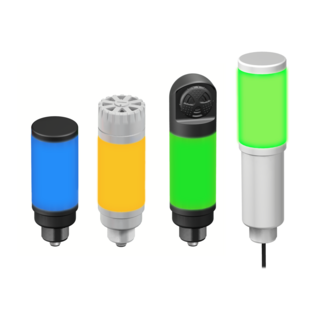
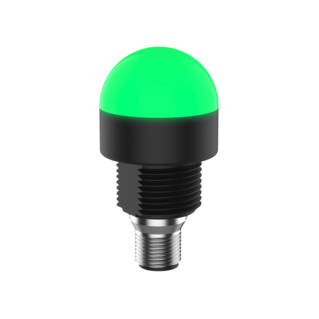
Banner’s indicators and Pro-enabled lighting products can quickly communicate different types of information. At Sussex IM, a CL50 Column Light mounted on the main panel provided a consolidated view of equipment faults, letting workers easily understand the system’s operational health. A K30 LED Indicator light was installed on each dryer so workers near the machine could quickly see the health of that particular piece of equipment.